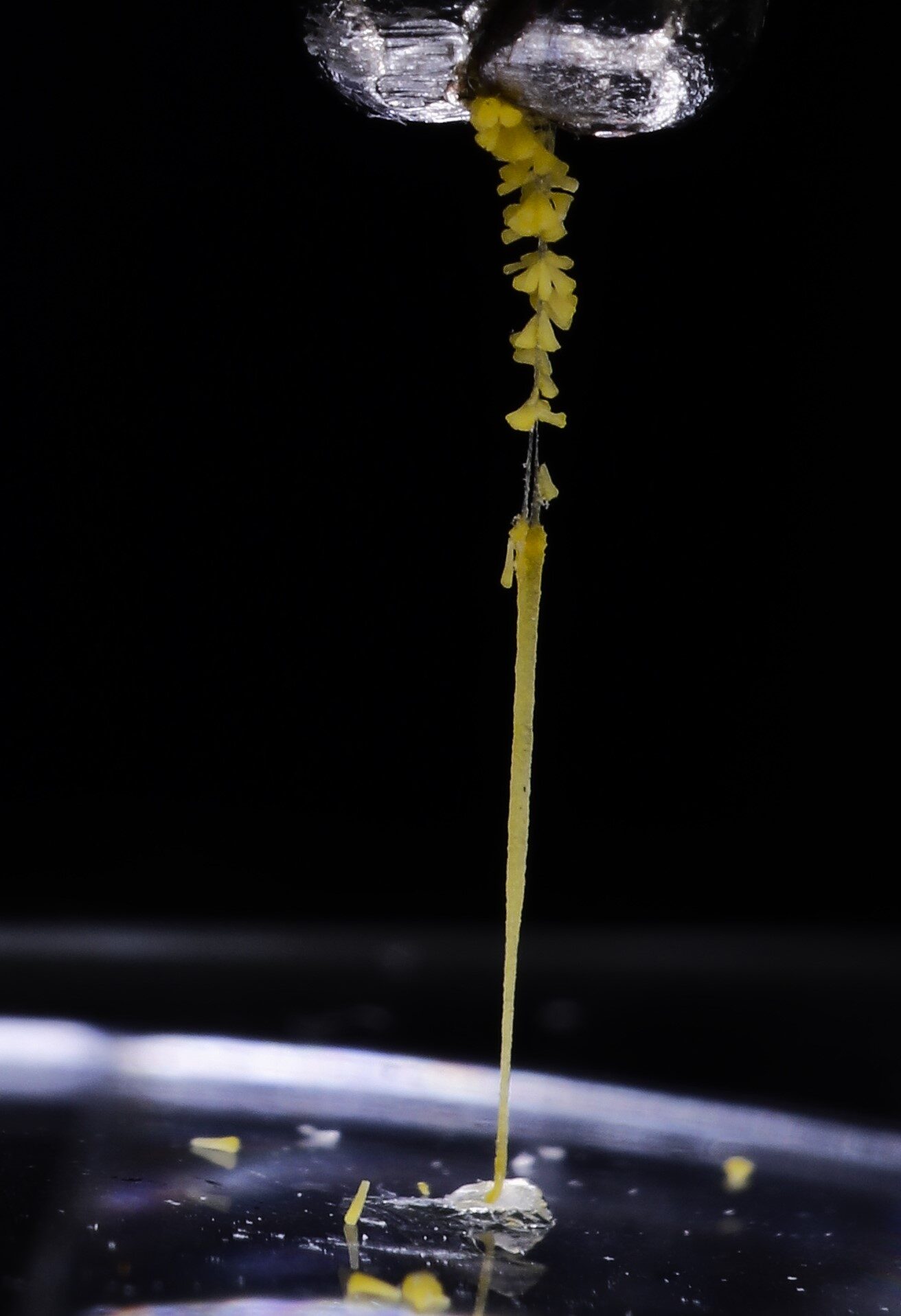
Pollinaria can concentrate many pollen grains into one transfer event, but a concentrated pollen load is not the same thing as a single father, and a single-sired fruit is not the same thing as a genetically monogamous plant. The current study separates those levels explicitly.
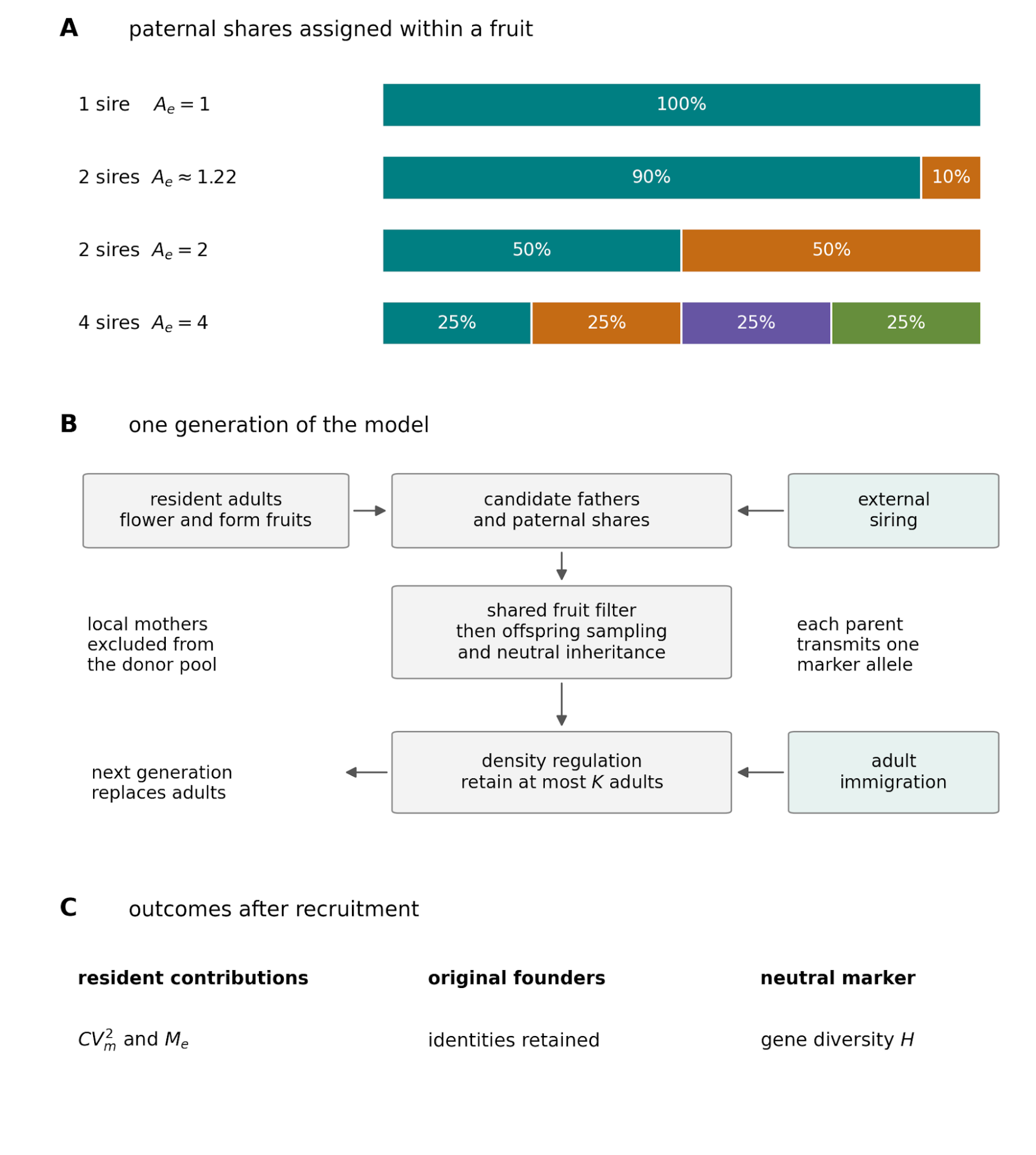
We follow three linked quantities: paternal shares within a fruit, summarised by effective sire number Ae; inequality in the contribution of resident males to retained recruits, measured by CV2m and the effective number of resident male contributors Me; and neutral-marker gene diversity H after recruitment and density regulation.
Core distinction. Pollinarium architecture can influence fruit-level paternity directly. Population-level consequences depend on what happens afterwards: how many independently sired fruits are produced, how many siblings establish together, how adults turn over, and how much genetic input arrives through external siring or immigration.
From paternity to recruitment
The model begins after pollination has generated paternal shares. It does not simulate flower mechanics as if they deterministically set paternity. Resident adults flower and form fruits, candidate fathers receive paternal shares, offspring pass through a shared fruit-level establishment filter and neutral inheritance, and density regulation retains at most the adult carrying capacity K. External siring and adult immigration enter at different stages.
What the empirical literature permits us to say
Published orchid paternity studies do not support a single family-wide rule. Strong within-fruit concentration is documented in systems including Phalaenopsis pulcherrima and Laelia rubescens, whereas Chiloglottis shows that cohesive pollinia can still produce multiply sired fruits. Loose- or granular-pollen reference systems provide the broader-paternity comparison. The pollinarium is therefore biological context for the model, not a guarantee that Ae = 1.
Multiple mating also occurs at more than one hierarchical level. A fruit may be single sired while different flowers on the same maternal plant are fertilised by different donors. The study therefore avoids treating fruit-level single paternity as plant-level monogamy.
Four matched paternity regimes
The main experiment compares four paternity architectures under the same demography in a closed population with K = 500: strict single sire, low sire, a granular reference and high mixing. Each regime was run for 50 generations across 100 replicate populations. A milkweed reference with Ae = 1 is retained separately because its demographic parameters differ; it is context, not a matched fifth regime.
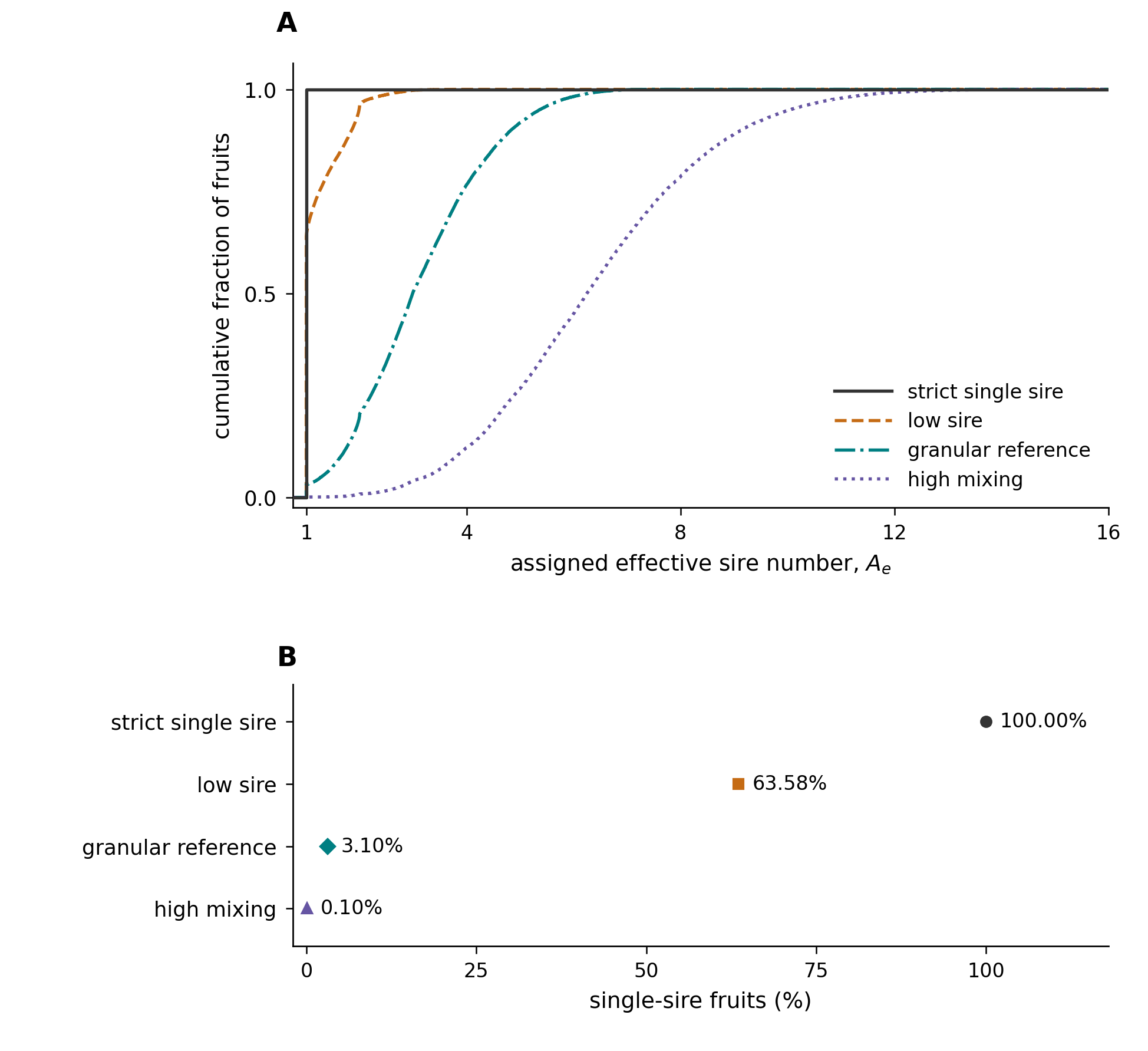
Ae = 1.000
Single-sire fruits = 100%
Mean Ae = 1.206
Single-sire fruits = 63.6%
Mean Ae = 3.148
Single-sire fruits = 3.10%
Mean Ae = 6.402
Single-sire fruits ≈ 0.10%
The matched population-level result
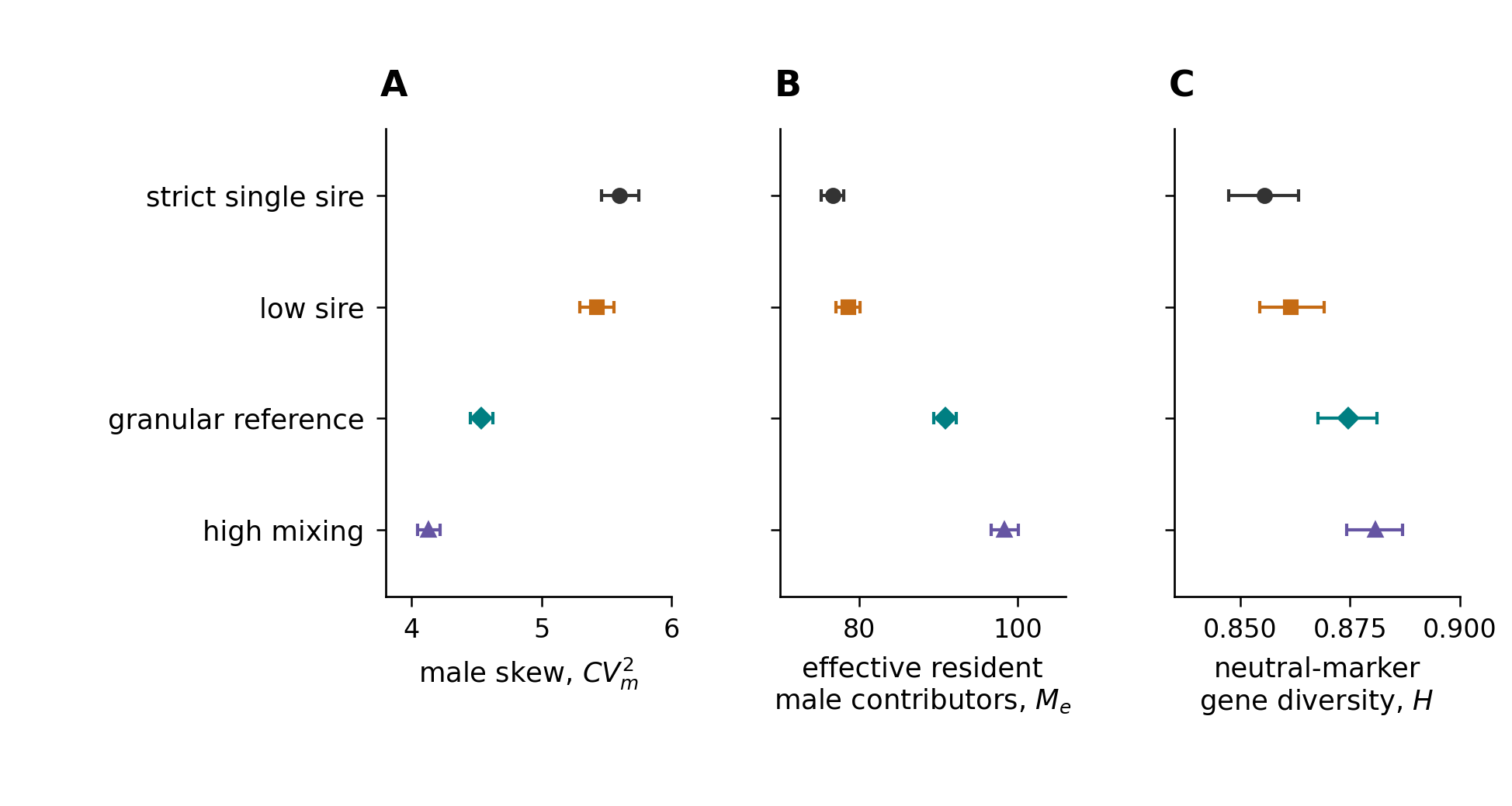
Holding demography constant reveals the direct signal of paternity concentration. At generation 50, strict single paternity raises resident-male contribution variance from CV2m = 4.539 in the granular reference to 5.599, while the effective number of resident male contributors falls from Me = 90.88 to 76.64. These are two summaries of the same contribution distribution, not independent measures.
The corresponding neutral-marker diversity values are H = 0.875 for the granular reference and 0.856 for strict paternity, a difference of 0.0191. The effect on resident male contribution is therefore clearer than the diversity effect.
Why the milkweed comparison matters. The separately parameterised milkweed reference also has Ae = 1, yet its modelled CV2m is 8.097 and Me is 55.60. That difference is not evidence that milkweeds intrinsically have greater skew; it demonstrates why paternity architecture cannot be interpreted apart from demography.
Why diversity loss is conditional
The model next compares strict and granular paternity across adult carrying capacities and two compound external-input settings. Strict paternity reduces Me in every setting shown, but the difference in neutral-marker diversity is much smaller under the higher-input setting. At K = 150 with lower input, the diversity interval crosses zero, so that contrast is unresolved.
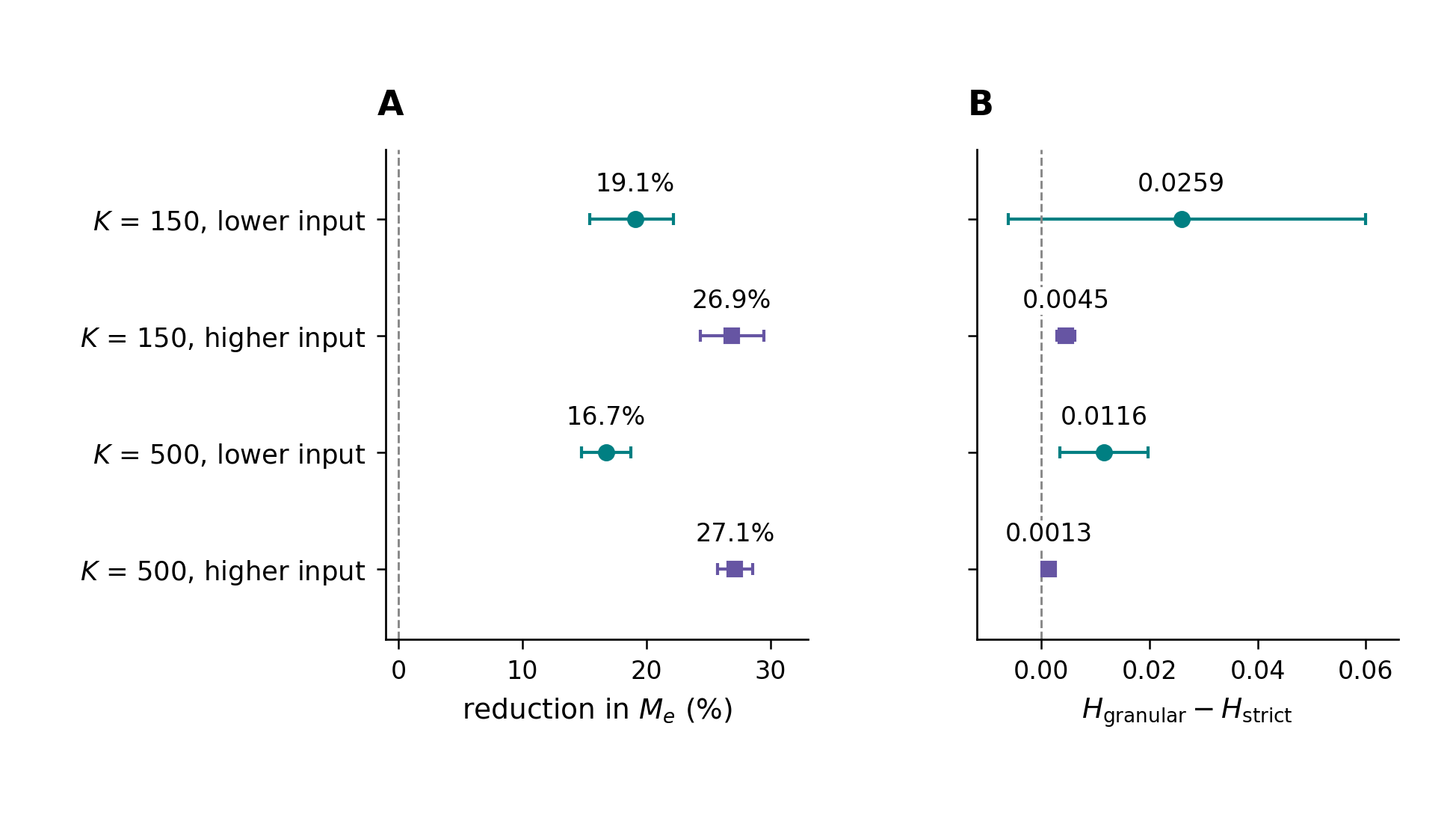
This distinction changes the interpretation of the study. Concentrated fruit paternity can increase inequality in resident male reproductive contribution, especially when multiple siblings from independently sired fruits recruit together. Whether that produces appreciable neutral-diversity loss depends on recruitment, population size and external genetic input. The model does not contain geographic distance, so the external-input scenarios should not be read as literal short- versus long-distance pollen-flow estimates.
What the model does not claim
- Me is an effective number of resident male contributors derived from realised paternal contributions; it is not total effective population size.
- H is diversity at a simulated neutral marker used as a tracer. Absolute values are not estimates of empirical genomic diversity in orchids.
- Pollinaria do not guarantee single paternity, and fruit-level single paternity does not imply that an adult plant has only one mate.
- The milkweed row is a separately parameterised demographic illustration, not a matched test of an intrinsic orchid-versus-milkweed difference.
- Self-incompatibility, pollinium subdivision, sequential visitation and post-deposition stigma behaviour remain mechanistic hypotheses to test directly; the simulations do not establish trait selection or speciation.
Interactive model walkthrough
The visual story follows the same hierarchy from pollinarium transfer to fruit paternity, inheritance, recruitment and the next adult generation. It is intended as a conceptual guide to the model rather than an additional analysis.
Manuscript
Orchid paternity: pollinaria, single-sire fruits, male reproductive skew and conditional diversity loss. Andrés E. Ramos R. Manuscript in preparation.
Research themes
- Effective sire number and exact single paternity within orchid fruits.
- Recruitment as the bridge between family structure and population-wide male reproductive skew.
- Resident male contribution measured with CV2m and Me.
- Conditional neutral-diversity effects under density regulation and external genetic input.
- Direct empirical tests of pollinium subdivision, sequential deposition, incompatibility and stigma-mediated exclusion.