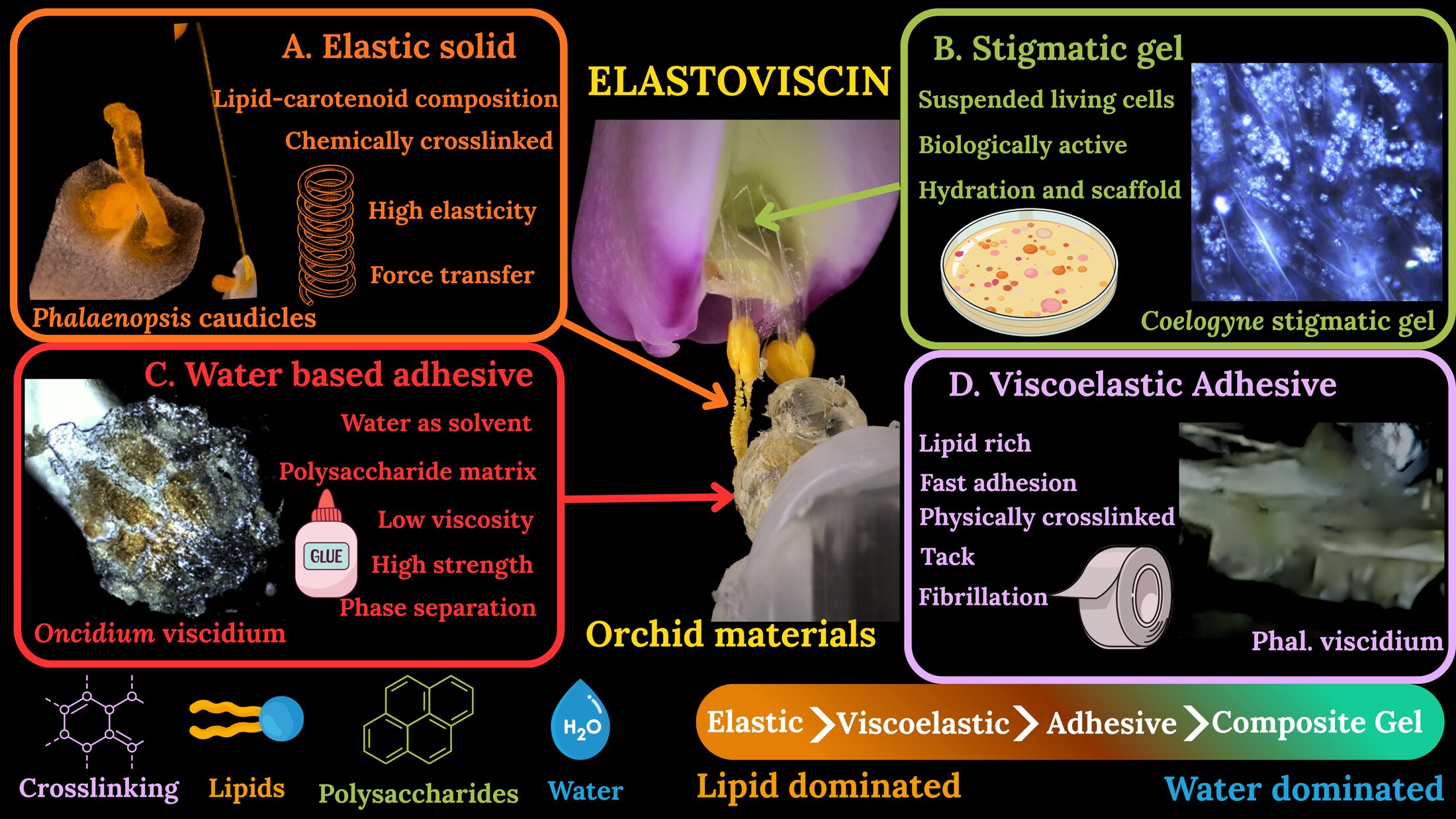
Orchids do not simply dust pollinators with loose pollen. Many lineages package pollen into compact pollinia and attach the whole structure to animal vectors using a specialised adhesive pad: the viscidium.
This research asks a materials-science question inside an evolutionary problem: are orchid reproductive adhesives a single conserved glue, or a diverse family of materials tuned to different pollination systems?
The biological problem
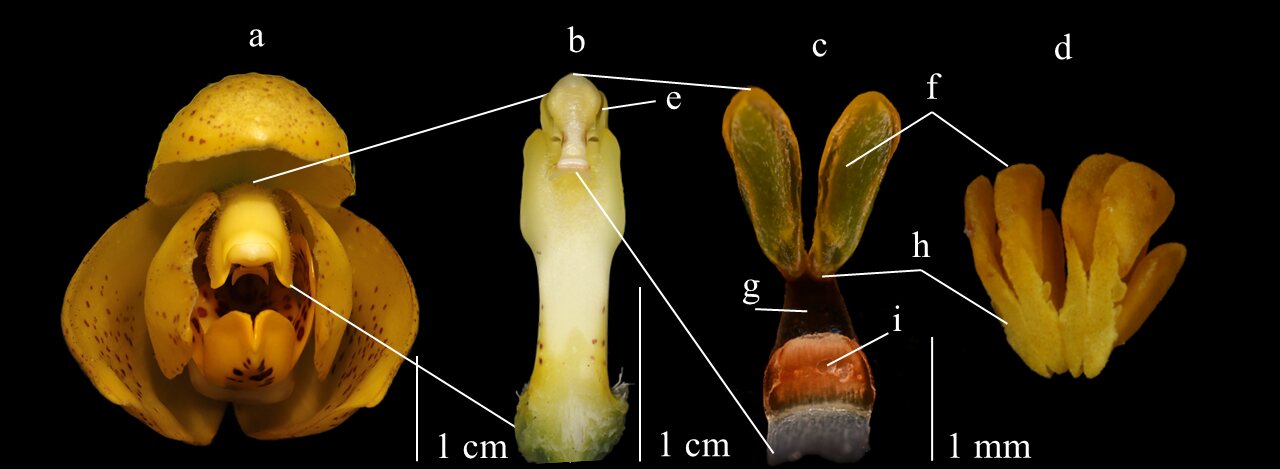
The orchid pollinarium is a composite pollen-transport structure. It includes pollen masses, structural elements such as stipes or caudicles, and an adhesive viscidium that forms the contact interface with the pollinator. For pollination to work, the adhesive must bond quickly, survive transport, and eventually allow the pollinia to contact the stigma of another flower.
That small adhesive interface has to work across radically different ecological scenarios: bee bodies, beetle exoskeletons, moth proboscises, bird beaks, humid cloud forests, hot glasshouse-like conditions, and floral visits lasting from seconds to minutes.
What we tested
The manuscript surveys reproductive adhesives from 22 orchid genera across Epidendroideae and Orchidoideae. It combines morphological observation, FTIR-ATR spectroscopy and quasi-static adhesion testing of both viscidia and stigmatic gels.
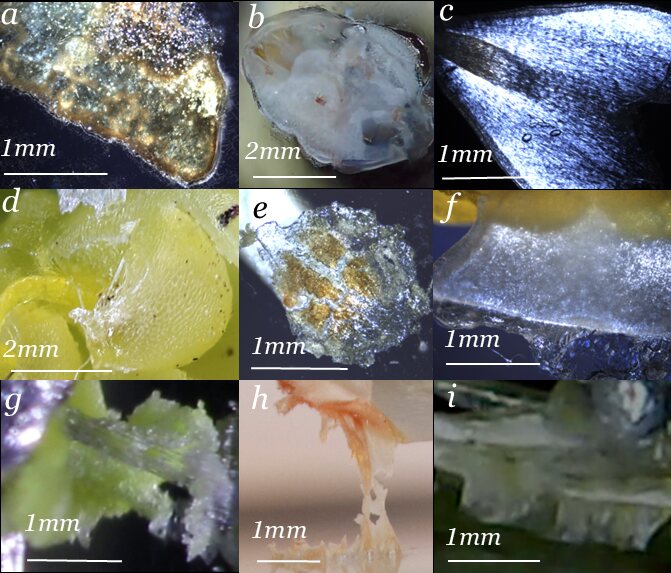
Observation of viscidium form, membrane enclosure, curing behaviour, deformation and failure mode.
FTIR-ATR spectra used to compare lipid, water, ester and polysaccharide-associated motifs.
Camera-assisted tensile tests measuring real contact area and peak adhesive stress on glass.
Three compositional classes
FTIR spectra reveal a small set of recurring chemical motifs that support three operational classes of orchid reproductive adhesives.
- Lipid-dominated adhesives. Strong CH₁ECH₁Epeaks, ester/carbonyl bands and low water signal. Phalaenopsis is the clearest example.
- Polysaccharide/water-dominated adhesives. Dominant water and C–O stretching signals, often with uronic-acid-associated features. Examples include Galeandra, Jumellea and Masdevallia.
- Intermediate lipid-polysaccharide systems. Mixed lipid and hydrophilic motifs, including genera such as Acineta, Cattleya, Oncidium, Psychopsis, Renanthera and Vanda.
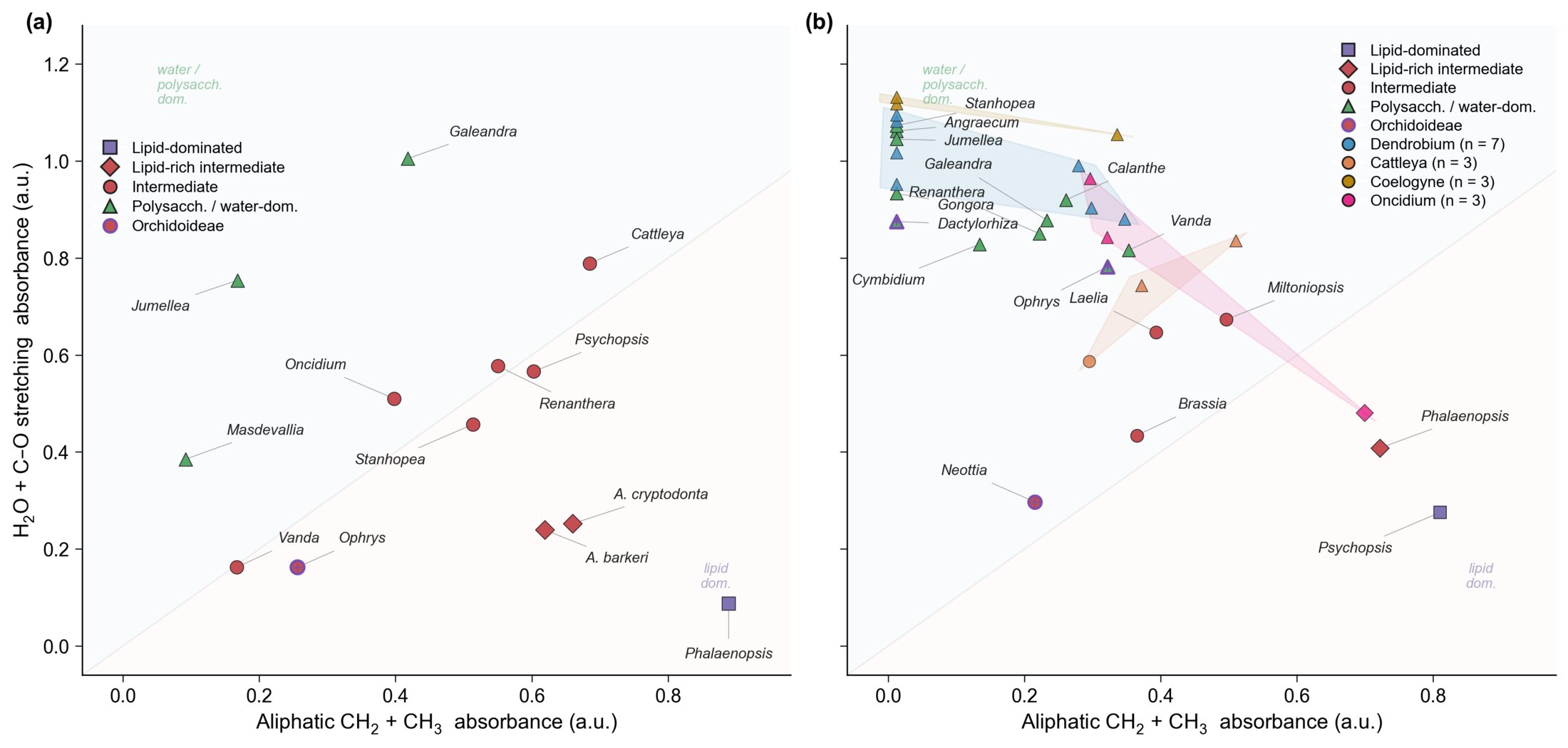
Key interpretation. Orchid pollination adhesives are not one conserved material. They form a chemically and mechanically diverse family of biological adhesives.
Mechanical diversity
Quantifiable adhesive strengths were obtained for three genera on glass: Vanda, Phalaenopsis and Acineta. Their behaviours were strikingly different.
- Vanda. A brittle, one-shot adhesive with sudden failure and strengths around 200 E60 kPa.
- Phalaenopsis. A lipid-rich viscoelastic adhesive showing fibrillation, partial reusability and strengths around 80 E50 kPa.
- Acineta. A thermally responsive adhesive, with an apparent transition between 15 and 25 °C and strength around 340 kPa at 25 °C.
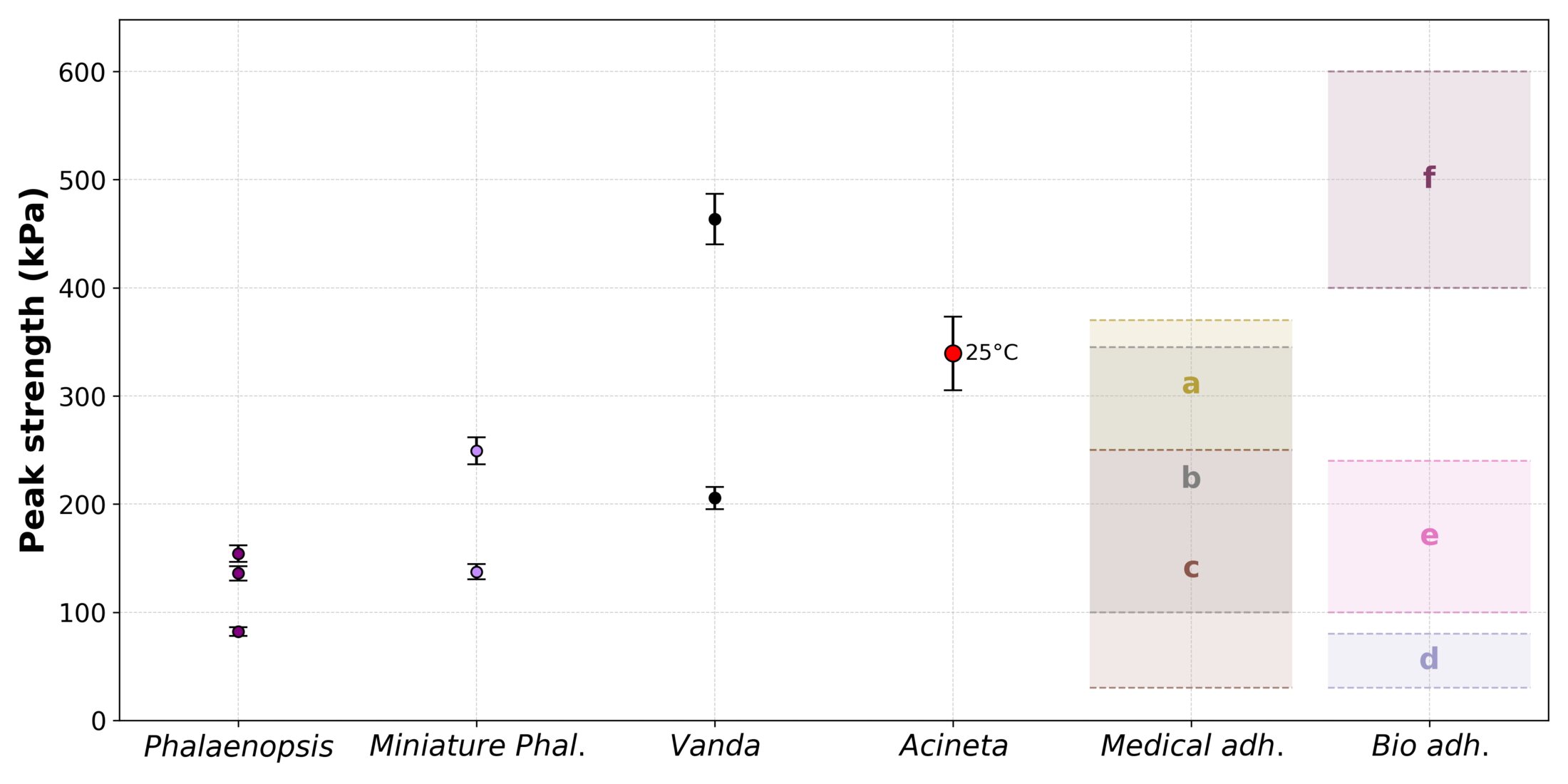
These values fall within ranges reported for several biological and medical adhesives under comparable loading conditions, though the manuscript treats them as contextual benchmarks because substrate, geometry and loading protocol strongly affect adhesion.
The Acineta thermal transition
Acineta showed the most unusual behaviour. At temperatures of 15 °C or lower, the adhesive did not flow even after the enclosing membrane was ruptured. Around 25 °C, it underwent a visually abrupt transition to a lower-viscosity orange liquid. Adhesive performance peaked near 25 °C and declined at lower and higher temperatures.
This makes Acineta a candidate system for thermally tuned plant adhesives, although the manuscript is careful not to overclaim the mechanism. Calorimetry, rheology and temperature-dependent modulus measurements are needed to distinguish glass transition, melting or phase separation.
Stigmatic gel as a hydrated analogue
Paired FTIR data suggest that the stigmatic gel and viscidium often share a chemical backbone, with the stigmatic gel generally showing higher water content. This supports the idea that these two reproductive materials are related products of the rostellum/stigmatic region but tuned for different functions: pollinator attachment versus pollen reception and germination.
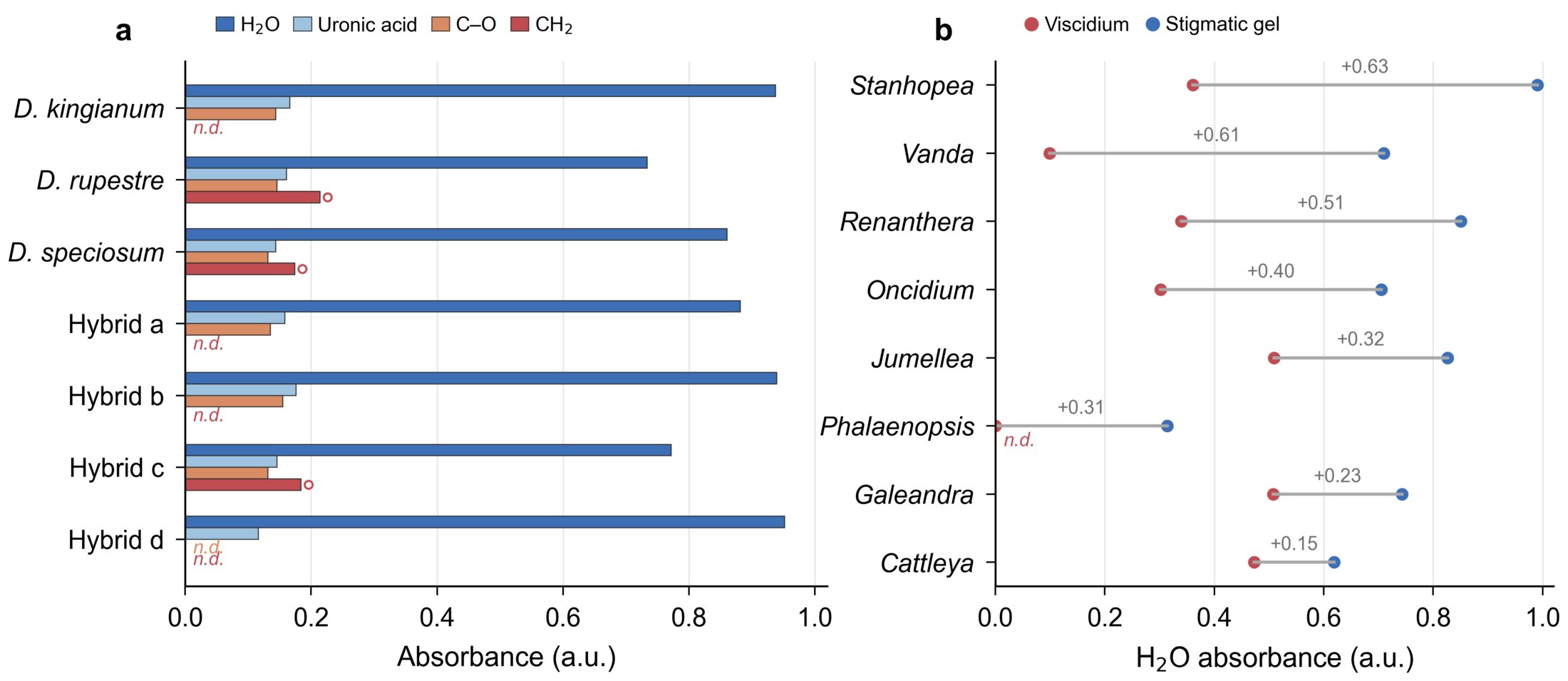
This is the bridge to the next phase of the PhD: treating orchid stigmatic gels as hydrated biological matrices with potential relevance to soft scaffolds, viscoelastic gels and bio-inspired adhesive hydrogels.
Biomimetic implications
The work identifies three design directions rather than claiming direct applications too early.
- Pressure-sensitive plant adhesives. Lipid-rich Phalaenopsis-like systems that remain tacky and reusable.
- Solvent-curing biological glues. Water-rich systems that cure rapidly after exposure.
- Thermally responsive adhesives. Acineta-like systems whose flow and wetting depend strongly on temperature.
The long-term goal is to understand the structure-property relationships behind these natural adhesives before translating them into biomimetic materials.
Current limitations and next steps
The manuscript deliberately defines what remains unresolved. Rheological properties, fracture energies, substrate-specific adhesion, ageing behaviour and phylogenetic comparative analyses are all priority targets. Future testing will move beyond glass to biologically relevant interfaces such as insect cuticle analogues, keratin and substrates with controlled surface energy and roughness.
Within Orchidarc, this research programme links conservation, evolution and biomaterials: the same orchid structures that enable pollination may also provide design principles for future soft adhesives.
Manuscript
Composition and mechanical diversity of orchid reproductive adhesives. Andres E. Ramos R., David A. Gregory, Tetsuo Yamaguchi, Adam P. Karremans and Chris Holland. Manuscript under revision for Journal of the Royal Society Interface.
Research themes
- Comparative chemistry of orchid viscidia and stigmatic gels.
- Mechanical testing of natural micro-adhesives under controlled loading.
- Evolutionary diversification of reproductive adhesive systems.
- Thermally responsive and pressure-sensitive plant adhesives.
- Biomimetic adhesive and hydrogel design inspired by Orchidaceae.